

Zinc vs Aluminium Sacrificial Anodes: What Actually Differs, and How to Choose
Quick answer
The headline difference is not voltage — it ischarge per kilogram. Aluminium–zinc–indium anodes carry roughly 2,500 Ah/kg in service against about 780 Ah/kg for zinc, so around 0.3 kg of aluminium alloy does the work of 1 kg of zinc. That is why aluminium dominates seawater, hulls and ballast tanks. Zinc dissolves more uniformly, is gentler on thin coatings and remains the correct choice in low-resistivity soil and modest-current brackish duty — but above roughly 50 °C it can reverse polarity and start protecting nothing while it corrodes steel instead.
Key takeaways
- They sit 50 mV apart, not 300. Design closed-circuit potentials are about −1.05 V for Al-based and −1.00 V for Zn-based alloys (Ag/AgCl/seawater) in DNV-RP-B401 — so "aluminium has a much stronger driving voltage" is not the reason to choose it.
- Capacity is the real separator. Theoretical 2,980 Ah/kg (Al) versus 820 Ah/kg (Zn); at practical efficiencies that is roughly 2,400–2,600 versus 740–780 Ah/kg.
- Temperature is a hard gate, and it cuts against zinc. Zinc anode surface temperature is limited to 50 °C; aluminium is permitted to 80 °C, with derating.
- Cadmium appears at 0.025–0.07% in zinc anodes under MIL-DTL-18001L and ASTM B418; Al-Zn-In chemistry is cadmium-free.
- Compare cost per amp-hour, not price per kilogram. The per-kg price gap is small; the capacity gap is a factor of three.
The difference in one table
| Property | Zinc (Zn alloy) | Aluminium (Al-Zn-In) |
|---|---|---|
| Design closed-circuit potential (Ag/AgCl) | ≈ −1.00 V | ≈ −1.05 V |
| Equivalent on the Cu/CuSO₄ scale | ≈ −1.09 V | ≈ −1.14 V |
| Theoretical capacity | 820 Ah/kg | 2,980 Ah/kg |
| Current efficiency | 95–98% | 80–90% |
| Practical capacity | ≈ 740–780 Ah/kg | ≈ 2,400–2,600 Ah/kg |
| Density | 7.14 g/cm³ | 2.70 g/cm³ |
| Dissolution pattern | Uniform, all over the surface | Uniform when the alloy is correct; pitting-prone if impurities or indium distribution are off |
| Temperature limit (anode surface) | 50 °C — polarity reversal above this | 80 °C, with capacity derating |
| Cadmium | 0.025–0.07% in MIL-DTL-18001L / ASTM B418 Type 1 chemistry | None; indium is the activator |
| Electrolyte it needs | Seawater, brackish water, low-resistivity soil with backfill | Chloride-bearing water — seawater, brine, produced water |
| Fails when | Hot service, or electrolyte too resistive for its driving voltage | Fresh water or soil, where the surface film stabilises and the anode passivates |
Why capacity, not potential, decides the choice
Both alloys are aluminium-family or zinc-family galvanic materials operating against steel in the same electrolyte. Their potentials are close because both are controlled by the same thing: the dissolution reaction of an active metal in chloride water. Measured open-circuit values cluster around −1.00 to −1.05 V (Ag/AgCl) for zinc and −1.05 to −1.10 V for Al-Zn-In, and design practice narrows that to −1.00 V and −1.05 V respectively.
Fifty millivolts matters when the electrolyte is resistive and the driving voltage is marginal — which is why zinc is unsuitable in dry soil. But in seawater, where the circuit resistance is dominated by coating condition and structure geometry rather than by the water, a 50 mV difference changes almost nothing. What changes everything is how much charge each kilogram can deliver before it is consumed.
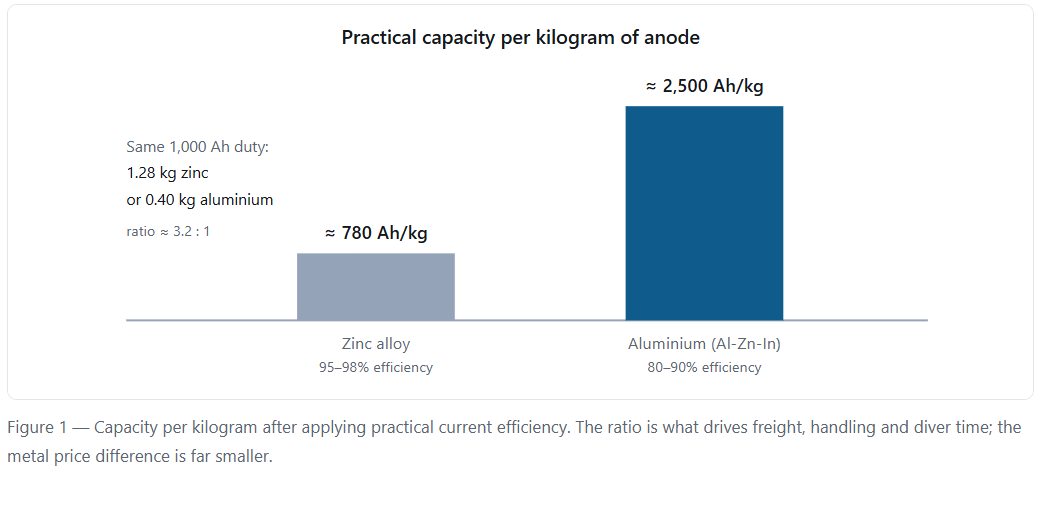
Figure 1 — Capacity per kilogram after applying practical current efficiency. The ratio is what drives freight, handling and diver time; the metal price difference is far smaller.
The arithmetic is worth doing once, because it is the whole argument:
| Duty | Zinc alloy at 780 Ah/kg | Al-Zn-In at 2,500 Ah/kg |
|---|---|---|
| 1,000 Ah | 1.28 kg | 0.40 kg |
| 10,000 Ah (≈ 1 A for 14 months) | 12.8 kg | 4.0 kg |
| 100,000 Ah (a large hull array) | 128 kg | 40 kg |
On a ship hull or a ballast tank, that difference is not an abstraction. It is 88 kg less metal to freight, lift, weld and replace mid-docking — and a proportionally shorter installation window. The same logic explains why aluminium dominates immersed marine work and zinc survives only where its other properties are worth the mass penalty.
The temperature question: where zinc actually breaks
This is the part of the comparison most often stated backwards. Zinc is the temperature-limited alloy, not aluminium.
Above roughly 50 °C in seawater, a zinc anode's potential shifts in the noble direction as the character of its corrosion-product film changes and iron from the steel diffuses into the anode surface. Somewhere around 50–60 °C that shift can carry the zinc potential positive of the steel it was meant to protect. The couple then reverses: the zinc becomes cathodic, the steel becomes the anode, and the assembly accelerates the corrosion it was installed to stop. Nothing visible happens at the surface; the structure simply starts losing metal faster than an unprotected one would.
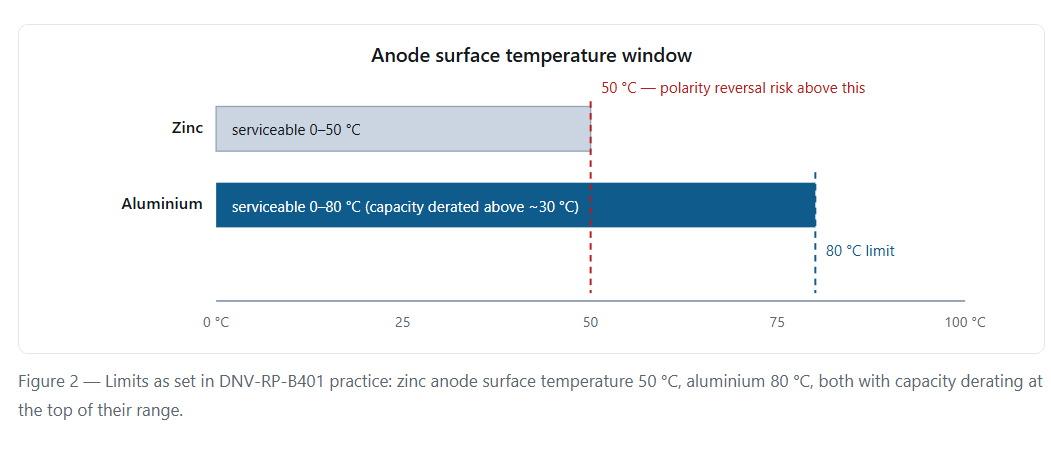
Figure 2 — Limits as set in DNV-RP-B401 practice: zinc anode surface temperature 50 °C, aluminium 80 °C, both with capacity derating at the top of their range.
Two consequences follow for specification writing:
- Ask for the temperature, not the water depth. A seawater-cooled heat exchanger, a produced-water line, a condensate tank or a jacket leg in a warm current can all be above 50 °C at the anode surface even when the bulk water reads lower. If the surface temperature cannot be kept below 50 °C, zinc is off the table regardless of how good the rest of the case looks.
- Choose the aluminium grade for the temperature. Standard Al-Zn-In is normally applied below about 30 °C without derating and becomes progressively less efficient above it; higher-temperature variants exist for hot seawater, and the design must use the capacity the supplier's test data supports at the actual temperature, not the room-temperature figure.
- The classic failure this prevents. A zinc anode installed on a hot seawater line does not obviously fail. It stays in place, it corrodes slowly, and it reads a plausible potential if the survey is taken at the wrong point. The only reliable signal is a potential survey taken at the structure, not at the anode, plus the temperature record. Where the two disagree with the design assumptions, the alloy — not the anode count — is usually what needs revisiting.
Cadmium, and why aluminium has become the easier specification
Zinc anodes are not pure zinc. The standard seawater chemistry under MIL-DTL-18001L and ASTM B418 Type 1 includes cadmium at 0.025–0.07%, along with controlled aluminium and strict limits on iron (below 0.005%) and copper. Cadmium is there for a metallurgical reason: it keeps the alloy's polarisation behaviour predictable and suppresses intergranular attack. It is also a restricted substance in a growing number of markets, and it enters the water column as the anode is consumed.
Al-Zn-In chemistry avoids that argument entirely. Indium at a few hundredths of a percent activates the surface and keeps the anode dissolving uniformly; zinc and silicon tune the potential and the microstructure. There is no cadmium, no mercury, and nothing on a restricted-substance list at the levels used. For a marine operator with an environmental management system, or a project in a jurisdiction that screens consumables, that single difference can remove a permitting conversation from the schedule.
Where cadmium is acceptable and zinc is otherwise correct, the specification still needs the composition certificate. Impurity control is what separates a 780 Ah/kg anode from a 500 Ah/kg one, and the certificates — not the datasheet — are the evidence. Certification and testing practice on both alloy families is described in our quality system and certification and compliance pages.
Cost: price per kilogram is the wrong number
Anode quotations are usually compared per kilogram, which answers a question nobody asked. The question is what a given protection duty costs, and the comparable unit is cost per amp-hour:
Cost per 1,000 Ah = (price per kg ÷ practical capacity in Ah/kg) × 1,000
With illustrative prices of USD 3.2/kg for zinc alloy and USD 4.0/kg for Al-Zn-In — a plausible ordering, since aluminium anodes carry alloying and casting cost — the arithmetic runs as follows:
| Item | Zinc alloy | Al-Zn-In |
|---|---|---|
| Assumed price per kg | USD 3.20 | USD 4.00 |
| Practical capacity | 780 Ah/kg | 2,500 Ah/kg |
| Cost per 1,000 Ah | ≈ USD 4.10 | ≈ USD 1.60 |
| Mass for a 100,000 Ah array | 128 kg | 40 kg |
| Freight index (same route) | 100 | ≈ 31 |
That is a 60% lower material cost per unit of charge, before freight, handling and installation labour are counted — and those follow mass almost linearly. The exception is small orders: a handful of 3 kg hull blocks can be cheaper in zinc simply because casting setup dominates, which is why small craft often still use zinc anodes for boats while anything with a real current demand moves to aluminium.
Coating compatibility and over-protection
Zinc's lower driving voltage is an asset on thin-film coatings. Because it pushes less current, the risk of cathodic disbondment at coating defects is lower, and a well-coated structure is less likely to be over-protected. Aluminium's higher capacity is not the problem — over-specifying anode mass is. An aluminium array sized on "more is safer" logic will drive excessive current at the start of life, blister the coating around holidays, and consume itself faster than the design intended.
The same caution applies on high-strength steels, where over-protection raises hydrogen-related cracking risk, and on aluminium hulls and structures, where the anode family must be compatible with the base metal. Where a structure carries a mix of coated and bare areas, the practical answer is often a hybrid: aluminium for the immersed bare steel, and a smaller zinc or aluminium block set for the coated compartments with restricted current demand, as in the bracelet aluminium anode format used on subsea pipelines.
Where each alloy wins
| Asset / condition | Recommended | Reason |
|---|---|---|
| Ship hulls, rudders, running gear in seawater | Aluminium | Highest charge per kg; fewer, lighter anodes for the same current demand — see the aluminium hull anode range |
| Ballast tanks and salt-water tank interiors | Aluminium | Chloride keeps the film active; restricted access makes long life decisive — aluminium tank anodes |
| Harbour piles, jetties, pontoons | Aluminium | Anode count drives cost on long immersed lengths |
| Seawater piping, strainers, heat exchangers below 50 °C | Either; aluminium preferred | Mass and replacement access decide |
| Hot seawater, produced water, condensate above 50 °C | Aluminium (high-temperature grade) | Zinc polarity reversal risk |
| Low-resistivity, well-aerated soil with gypsum-bentonite backfill | Zinc | Lower drive is sufficient; zinc has the longest soil service life — prepackaged zinc anodes |
| Buried tanks, grounding, small current demand in moist soil | Zinc | Uniform dissolution, low self-consumption, gentle on coatings — zinc tank anode |
| Fresh water, river craft, water tanks | Neither — magnesium | Both zinc and aluminium lose activity or drive in low-chloride water; see magnesium versus aluminium |
| Aluminium hulls | Aluminium (compatible alloy) | Base-metal compatibility; avoids galvanic attack on the hull itself |
| Brackish and estuarine water | Aluminium | Stays active across the salinity swing — the case is set out in why aluminium anodes perform better in seawater |
Form follows the asset, and the same two alloys cover most of it: a disc aluminium anode for seawater boxes and heat-exchanger water chambers, a zinc hull anode where a small block on a well-coated hull is genuinely enough, and a zinc ribbon anode for the buried runs that a casting cannot follow.
Five checks before the purchase order
- Temperature at the anode surface, not the bulk water temperature. Above 50 °C, zinc is excluded.
- Chloride content. Aluminium needs chloride to stay active; fresh water is magnesium territory, and specifying aluminium there is a common and expensive error.
- Composition certificate against the standard — ASTM B418 or MIL-DTL-18001L for zinc, EN 12496 for aluminium and zinc in seawater service. Iron is the impurity that quietly halves efficiency.
- Capacity at the design temperature, not at 20 °C. Ask for the electrochemical test data behind the number.
- Cost per amp-hour, computed the same way for both offers, with freight and installation labour included.
FAQ: zinc versus aluminium anodes
Is aluminium a stronger anode than zinc?
Only marginally, in voltage terms: about −1.05 V versus −1.00 V against Ag/AgCl, a 50 mV difference. The real difference is capacity — roughly 2,500 Ah/kg versus 780 Ah/kg in service, a factor of about three. Aluminium is preferred in seawater because it lasts far longer per kilogram, not because it drives much more current.
Why do zinc anodes fail in hot water?
Above roughly 50 °C the zinc potential shifts positive as its corrosion-product film changes and iron diffuses into the surface. At some point the zinc becomes cathodic to the steel, the couple reverses, and the "anode" starts driving corrosion of the structure instead of preventing it. DNV-RP-B401 limits zinc anode surface temperature to 50 °C for this reason.
Can I use an aluminium anode in fresh water or soil?
No. Aluminium relies on chloride to keep its surface film soluble and the anode active. In fresh water or buried soil the film stabilises, the anode passivates, and current output collapses. Fresh water and soil are magnesium duties, with zinc reserved for low-resistivity soil where its lower driving voltage is still sufficient.
Which anode contains cadmium?
Zinc anodes. MIL-DTL-18001L and ASTM B418 Type 1 chemistry specifies cadmium at 0.025–0.07%. Al-Zn-In anodes are cadmium-free and use indium as the activator, which is one reason they are easier to specify in markets with restricted-substance rules.
Is aluminium really three times more efficient?
Per kilogram of anode mass in seawater, yes — about 2,500 Ah/kg against 780 Ah/kg after efficiency is applied. That ratio holds because aluminium's theoretical capacity is 2,980 Ah/kg against 820 Ah/kg for zinc, even though aluminium's current efficiency (80–90%) is lower than zinc's (95–98%).
Why is aluminium more prone to pitting than zinc?
Because aluminium's activity depends on a small indium addition and on a clean, single-phase microstructure. Segregation, iron or silicon contamination, or poor casting practice create local galvanic cells that pit instead of dissolving uniformly, and efficiency drops accordingly. Zinc's advantage is metallurgical simplicity: a correct alloy dissolves evenly almost regardless of geometry.
Does a higher-capacity anode damage coatings?
Not by itself — damage comes from over-protection. If an aluminium array is sized generously, initial current output can exceed what the coating can tolerate at defects, causing cathodic disbondment. Size the array on current demand and design life, then check the initial output against the coating's tolerance.
Can zinc and aluminium anodes be mixed on one structure?
They can, and on mixed assets it is often sensible: aluminium for the large immersed bare surfaces, zinc for coated compartments with small current demand. The two must be electrically coordinated, because the more active aluminium will drive current through the zinc circuit if they are bonded without thought — which shortens the zinc's life and under-uses the aluminium.
Standards and references
- ASTM B418 — Standard Specification for Cast and Wrought Galvanic Zinc Anodes
- MIL-DTL-18001L — Anodes, Sacrificial Zinc Alloy (composition and inspection)
- EN 12496 — Galvanic anodes for cathodic protection in seawater and saline mud
- DNV-RP-B401 — Cathodic Protection Design (design potentials, anode temperature limits, capacity derating)
- NACE/AMPP SP0169 — Control of external corrosion on underground or submerged metallic piping systems
- ISO 15589-1 — Cathodic protection of pipeline transportation systems: on-land pipelines
- AUE, zinc anode range and aluminium anode range
- AUE, aluminium sacrificial anode selection and installation
Tell us the electrolyte and we will confirm the alloy
Send the water or soil analysis, the operating temperature at the anode surface, the coating system, the structure area and the target design life. We will return the alloy recommendation, the mass calculation behind it and the anode schedule — for a hull, a tank, a pipeline or a mixed structure.Contact our engineering team
Xi'an AUE Technology Co., Ltd. (anodeae.com) has manufactured cathodic protection materials and electrochemical systems for more than 21 years, casting zinc, aluminium and magnesium sacrificial anodes to ASTM, MIL and EN chemistry with third-party composition and electrochemical testing, and supplying complete ICCP packages to projects in more than 120 countries.

