

Why Choose Magnesium Anode Rods for Water Heaters: 7 Engineering Reasons
Short answer: Magnesium is the most electrochemically active of the three common anode metals, so a magnesium rod protects a steel tank at the lowest water conductivity, including softened and low-mineral water where aluminium and zinc rods run out of driving voltage. The reasons that follow cover protection strength, water quality, mechanical construction, life-cycle economics, environmental logic, thread compatibility, installation and long-term peace of mind — plus the one case where magnesium is the wrong choice and an aluminium or zinc rod should be specified instead.
Reason 1: the strongest driving voltage of any anode metal
An anode rod works by being more negative than the steel it protects. Magnesium sits at the top of that galvanic order for water-heater service, which means it keeps delivering protective current even when the water is soft, low in dissolved solids or partially de-mineralised — conditions where aluminium and zinc alloys polarise and lose output. In practical terms: the rod keeps working across a wider range of water chemistry, and the tank stays protected when a water softener or a low-mineral supply would otherwise leave a weaker anode passive. The mechanism is the same one described in our guide to sacrificial anode cathodic protection.
Above roughly 40 °C the reaction rate inside a tank accelerates and scale begins to form on the tank wall and heating element. That is exactly the regime where anode output matters most, and where a marginal anode stops protecting while still looking intact from the outside.
Reason 2: water quality and the odour question, answered honestly
Water quality is the reason buyers ask about anode chemistry, and the honest answer is more useful than a blanket claim. The "rotten egg" smell in a hot water system is hydrogen sulphide produced by sulphate-reducing bacteria acting on sulphate in the water. The anode feeds that reaction with protective current, so the stronger the anode, the more the odour can be aggravated in a tank with an established bacterial population and a sulphate-bearing supply.
The exception worth knowing: if a tank already has a sulphate odour problem, industry practice is to move away from magnesium and specify an aluminium alloy or zinc rod, which delivers lower current and reduces the substrate for the bacteria. We supply those too — see the aluminium anode rod for water heaters. Magnesium remains the right default for the majority of installations where odour is not an issue.
What controlled magnesium chemistry does deliver is repeatability: low iron, copper and nickel impurity levels limit parasitic local corrosion, so the rod dissolves uniformly from the surface instead of pitting through in one spot and shedding metal into the tank. That is a manufacturing discipline, not a marketing claim — it is verified by composition testing on each batch.
Reason 3: built to survive the installation, not just the chemistry
Most premature anode failures are mechanical, not electrochemical. Three construction details decide whether a rod reaches its design life:
- Welded steel core, correctly sized. The core carries both the structural load and the electrical path. Our rods run 2.0 mm to 4.8 mm cores depending on anode diameter, welded into the rod so the assembly survives the extraction torque after years of service instead of snapping at the thread.
- Uniform alloy density. Casting porosity creates preferential corrosion paths. Controlled density means the rod sacrifices evenly along its full length, which is what the design calculation assumes.
- Consistent unit weight per centimetre. Published weight-per-length figures (2.83 g/cm at φ13.97 up to 37.96 g/cm at φ51.40) let an OEM calculate service interval instead of guessing it.
Reason 4: the cheapest maintenance item on the appliance
A rod is a consumable, and that is precisely its value: it is designed to be the part that fails. Replacing a rod is routine maintenance measured in a service call and a low-cost component. Replacing a tank is a capital event — the appliance, the removal, the disposal, the reconnect, and in many markets the leak damage that triggered it. The ratio between the two is the whole economic argument, and it holds whether you are a householder or a plant manager looking at a bank of 40 heaters.
| Event | Cost character | Frequency |
|---|---|---|
| Anode rod replacement | Low, predictable, consumable | Every 3–6 years depending on water chemistry and rod mass |
| Descaling and element service | Low to moderate | As scale dictates, worse in hard water |
| Tank failure and replacement | High, plus downtime and possible water damage | Brought forward sharply once the anode is spent |
Reason 5: extending asset life is the environmental argument
The sustainability case for an anode rod is not about the metal in the rod; it is about the appliance that does not get manufactured, shipped and scrapped. A heater that reaches 12 years instead of 7 avoids one full manufacturing cycle, one disposal cycle and the associated embodied carbon. Magnesium is also an abundant, recyclable metal, and the mass involved is small — a rod is a few hundred grams to a couple of kilograms against a 50–200 kg appliance.
For buyers with procurement scoring, the practical framing is: one low-mass consumable, replaced on schedule, in exchange for several additional years of appliance life. That is a defensible line on an ESG questionnaire, and it is measurable if maintenance records are kept.
Reason 6: standard threads, real compatibility, easy installation
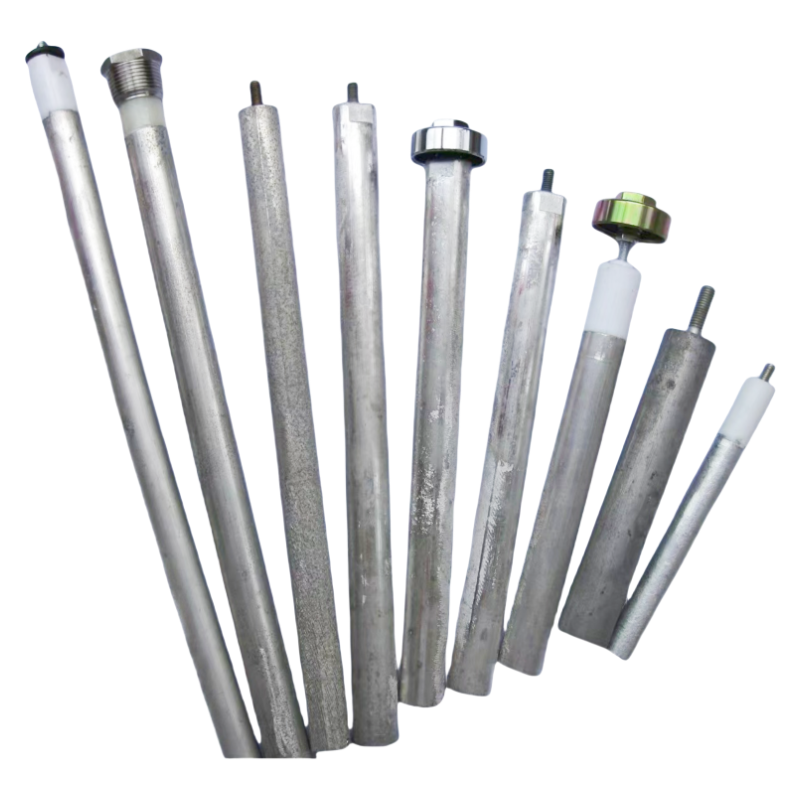
Compatibility is where anode replacement usually fails, so the range is built around the fittings that actually exist in the field. Both screw-in and bolt-in configurations are standard, and because the diameters and threads span the common residential and commercial port sizes, a rod can be matched to most standard water heater models without an adapter:
| Type | Anode diameter | Thread / fitting | Typical use |
|---|---|---|---|
| Screw-in rod | φ13.97–φ51.40 mm, core 2.0–4.8 mm | NPE, ASMT, BSP, G, R | Standard residential and commercial tank ports |
| Bolt-in rod | φ12.7–φ33.40 mm | Internal 1/4-18 to 3/4-14 NPT; external 3/4-14 to 1 1/4-11 1/2 NPT | Tanks with a bolt-on hex head or separate port adapter |
| Flexible four-section rod | As specified, linked sections | Carbon steel wire or 301 stainless braided core | Low ceilings, closets, attics, under stairwells — anywhere a straight rod cannot be inserted |
| Solar and custom rods | Custom length and diameter | To drawing | Solar tanks, non-standard ports, OEM programmes |
The flexible configuration deserves a note: it exists because replacement access, not tank design, is what blocks most anode changes. A four-section rod that articulates through a tight closet converts a job that would otherwise be deferred — and a deferred anode change is how a tank reaches the end of its life early. See the flexible magnesium water heater anode rod for the linked version and the solar water heater rod for that variant.
Installation itself is a homeowner-level task on most tanks: isolate the power and water, drain below the port, break the seal, extract the spent rod, clean the thread, fit the new rod with approved thread sealant, torque to the tank manufacturer's figure, then refill and vent. Each rod ships with fitting instructions and the accessories the job needs — thread sealant, washers or the port adapter — so the replacement does not stall halfway through for a missing part. Two points decide whether it goes smoothly: match the thread before ordering, and confirm the rod clears the ceiling or closet once inserted, which is where the flexible version earns its place.
The one non-negotiable rule in either case is that the rod must not be painted, coated or wrapped — the working surface has to stay bare to dissolve. A rod that is protected from the water cannot protect the tank.
Reason 7: a maintenance partner, not a one-off part
What a rod actually buys is not metal — it is the absence of an event. A tank that fails without warning sends water into a ceiling, a closet or a plant room, and the repair bill is measured well beyond the appliance itself. Renewing the rod on schedule is the cheapest way to keep that failure out of the plan: the tank keeps holding pressure, the water supply stays clean, and the element works against a protected surface instead of a slowly thinning one.
Four things follow from that, and they are why the rod belongs in a maintenance routine rather than a purchase history:
- Water damage stays theoretical. Corrosion perforates a tank from the inside, where nobody is looking, and the first symptom is usually a leak.
- Water quality stays consistent. A working anode keeps the tank interior from becoming a corrosion-product reservoir, so taste and clarity do not drift with the age of the appliance.
- Efficiency holds. A sound tank wall and a clean element transfer heat as designed; a scaled, corroding tank makes the same hot water for more energy.
- Service life extends. The appliance stays in service for years longer, which is the environmental argument from Reason 5 expressed as a household budget line.
For distributors and manufacturers, the same logic scales. Volume programmes can combine configurations in one shipment — screw-in rods for the residential line, bolt-in rods for commercial tanks, flexible rods as a service part — with composition and unit-weight verification per batch, and non-standard diameters, lengths or threads produced through the customised magnesium water heater anode rod route. The complete accessory range sits under water heater accessories.
When magnesium is the wrong choice
A guide that only lists reasons to buy is not a guide. Three situations call for a different alloy or a different solution:
| Situation | Why magnesium underperforms | Correct specification |
|---|---|---|
| Sulphate odour already present in the hot water | High current output aggravates the bacterial sulphate reduction that produces H2S | Aluminium alloy or zinc rod, plus water treatment review |
| Aluminium tank or aluminium components in the water path | Galvanic incompatibility and risk of localised attack | Aluminium alloy anode matched to the base metal |
| Very long service interval with no access for inspection | Highest consumption rate of the three alloys | Larger-mass rod, or zinc/aluminium where chemistry allows |
Frequently asked questions
How often should a magnesium anode rod be replaced?
Inspect annually and replace when roughly half the original diameter is consumed. In practice that falls between three and six years depending on water chemistry, tank temperature and rod mass. Soft or aggressive water shortens the interval; a larger-diameter rod extends it.
How do I know which rod size my tank needs?
Match the port thread first, then choose the largest diameter and length that physically fits the tank. The thread determines compatibility; the mass determines how long the protection lasts. If the port is non-standard, a custom rod to drawing is cheaper than adapting the tank.
Can I install a flexible rod if I cannot fit a straight one?
Yes — that is exactly what the four-section flexible rod is for. It articulates through low ceilings, closets, attics and under-stair installations where a rigid rod cannot be aligned with the port.
Does a magnesium rod make the water smell?
Not by itself. Odour comes from sulphate-reducing bacteria converting sulphate to hydrogen sulphide, and the anode's current can feed that process. If odour appears, the practical fix is an aluminium or zinc alloy rod plus a water-quality review, not a larger magnesium rod.
Will a magnesium rod work with softened water?
Yes, and this is one of its strongest cases. Softened water has low conductivity, which weakens aluminium and zinc anodes; magnesium's higher driving voltage keeps the tank protected where weaker alloys would go passive.
Is the rod safe in drinking-water tanks?
Magnesium anodes are the conventional choice for potable-water heaters and are used across residential and commercial appliances. Confirm the specific alloy and any local potable-water compliance requirement with the tank manufacturer when specifying for a regulated market.
Do you supply rods to OEM drawings?
Yes. Diameter, length, core size, thread type and packaging can all be produced to drawing, with composition and unit-weight verification per batch. Send the drawing and annual volume through the engineering contact form for a specification review.
Specification summary
The standard range covers screw-in rods from φ13.97 mm to φ51.40 mm with unit weights from 2.83 to 37.96 g/cm, bolt-in rods from φ12.7 mm to φ33.40 mm with NPT internal and external threads, four-section flexible rods on carbon steel or 301 stainless braided core, and custom solar and OEM configurations. Full data sheets sit on the magnesium water heater anode rod product page, with the broader magnesium range under magnesium anodes.
About the author. Prepared by the engineering team at Xi'an AUE Technology Co., Ltd. (anodeae.com), a manufacturer of magnesium, aluminium and zinc sacrificial anodes and water heater anode rods, with more than 21 years of experience, NACE/AMPP-certified engineers, ASTM/ISO-tested production and customers in more than 120 countries. Specification values above are taken from our published product data for magnesium water heater anode rods.

