

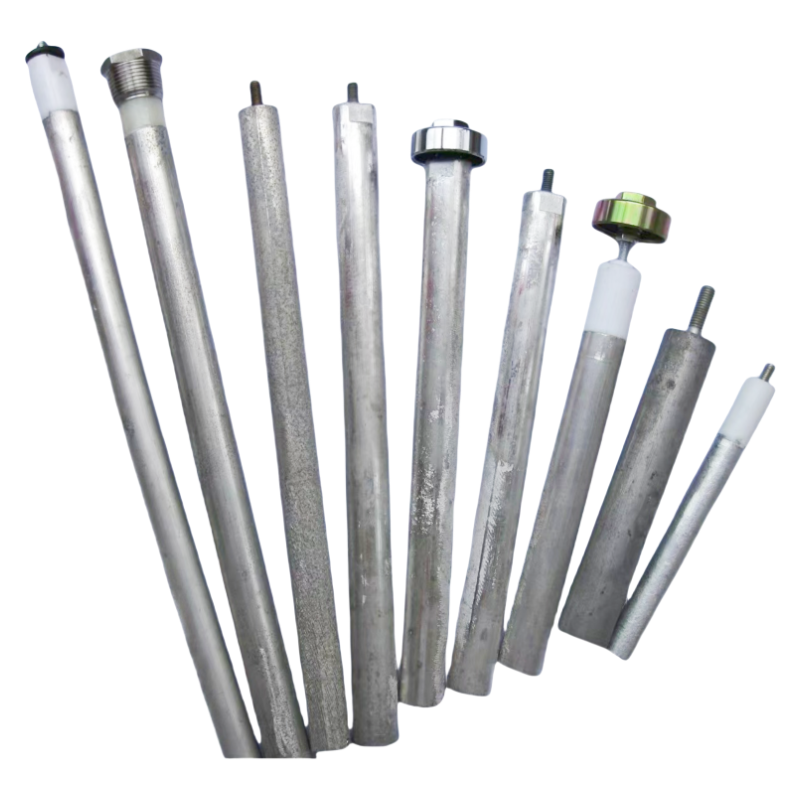
Extruded Magnesium Anodes: A Complete Guide to Production, Applications and Selection
An extruded magnesium anode is a sacrificial anode made by hot‑extruding AZ31B magnesium alloy around a continuous steel core. The extrusion produces a dense, porosity‑free rod with a smooth surface, uniform grain structure and a magnesium balance of about 95%, which dissolves predictably and delivers stable protection current. Extruded rods are the standard choice for water‑side protection of steel tanks, water heaters, boilers and heat exchangers — not for buried structures, where cast anodes with backfill are used.
Key takeaways
- Extrusion, not casting, is what gives the rod its density, dimensional accuracy and predictable dissolution — the properties that matter in a threaded, replaceable water‑heater anode.
- Performance is set by chemistry as much as by process: nickel, iron and copper limits in AZ31B determine current efficiency more than the aluminium or zinc content does.
- Extruded anodes are a water‑side product. For soil and buried service, specify cast magnesium anodes with backfill.
- Sizing follows from tank volume, water chemistry, temperature and desired service interval — not from "the size that fits the port".
- Replace on measured consumption (roughly two‑thirds of the original mass consumed), not on a fixed calendar year.

1. What is an extruded magnesium anode?
An extruded magnesium anode is a sacrificial anode formed by pushing a heated magnesium alloy billet through a die to produce a continuous rod of uniform cross‑section, with a steel core running the full length of the anode.
Three design consequences follow from that process:
- It is consumed instead of the steel. Magnesium sits well above steel in the galvanic series, with an open‑circuit potential of roughly −1.55 V vs Cu/CuSO4 for AZ31B and −1.70 to −1.75 V for high‑potential M1C grades. Connected to a steel tank in water, the magnesium becomes the anode of the cell and corrodes preferentially, discharging the current that keeps the steel cathodic.
- It is replaceable. Extruded rods are made with a threaded steel plug or nut welded to the core, so the anode can be unscrewed from a tank port and replaced without cutting or welding on site.
- It is dimensionally repeatable. Extrusion holds diameter, core position and straightness within tight tolerances, which is what allows a rod to pass through a narrow heating‑element port and seal correctly.
That combination — electrochemical activity plus mechanical precision — is why extrusion dominates the water‑heater and small‑tank segment, while casting still dominates soil and large immersed structures.
2. How extruded magnesium anodes are produced
The manufacturing route is short but sensitive at every step.
| Step | What happens | Why it matters to the buyer |
|---|---|---|
| 1. Billet casting and homogenisation | AZ31B billet is cast and homogenised to even out segregation | Controls grain structure and prevents banded corrosion later |
| 2. Billet heating | The billet is heated to extrusion temperature | Too cold → cracking; too hot → grain growth and reduced strength |
| 3. Hot extrusion | Billet is forced through a die around the steel core | Sets diameter, density and surface finish in one pass |
| 4. Straightening and cutting | Rod is straightened and cut to length | Straightness tolerance governs fit in narrow ports |
| 5. Plug / nut welding | Steel hex plug or nut is welded to the core | The weld is the mechanical and electrical joint — it must not be a press fit |
| 6. Threading, machining, marking | NPT or BSP thread cut, ends faced, lot marked | Determines sealing and traceability |
| 7. Testing and packing | Chemistry, dimensions, weight, core pull and coating checks | Certificate data should match the lot, not the catalogue |
The critical quality point is step 3 combined with step 5. Extrusion produces a dense, fine‑grained structure with no casting shrinkage porosity, so the anode dissolves from the surface inward instead of shedding lumps. And because the steel core carries all the mechanical load, the core‑to‑plug weld is the single joint that decides whether the anode stays attached for its whole service life.
3. Material science: why AZ31B chemistry decides performance
Extruded anode rods are normally made from AZ31B (UNS M11311). Its composition is deliberately balanced: enough aluminium and zinc to strengthen the alloy and control potential, manganese to tie up iron, and a magnesium balance of roughly 95%.
| Element | Typical anode‑grade limit | Function |
|---|---|---|
| Aluminium (Al) | 2.5–3.5 % | Solid‑solution strengthening; shifts potential and controls dissolution morphology |
| Zinc (Zn) | 0.6–1.4 % | Improves castability and electrochemical uniformity |
| Manganese (Mn) | 0.2–1.0 % | Scavenges iron, reducing self‑corrosion |
| Silicon (Si) | ≤0.10 % | Kept low; excess forms coarse intermetallics |
| Copper (Cu) | ≤0.01 % | Strictly limited — cathodic inclusions accelerate self‑corrosion |
| Iron (Fe) | ≤0.005 % | Strictly limited — the single largest driver of efficiency loss |
| Nickel (Ni) | ≤0.001 % | Strictly limited — even trace levels act as cathodic sites |
| Magnesium (Mg) | Balance (~95 %) | The sacrificial element |
The reason nickel, iron and copper receive their own limits rather than a generic "impurities" note is electrochemical: each forms cathodic micro‑sites inside the anode. Those sites generate hydrogen and consume magnesium without delivering useful protection current, so current efficiency falls and the anode disappears before its design life. This is why two rods with "the same AZ31B" specification can behave very differently — the difference is usually the impurity control and the iron/manganese ratio, not the headline alloy name.
Design values to use in calculations (seawater and water service, per DNV‑RP‑B401 and manufacturer data):
| Grade | Open‑circuit potential | Design capacity | Current efficiency |
|---|---|---|---|
| AZ31B (standard) | ≈ −1.55 V vs CSE | ≈ 1,100 Ah/kg | ≈ 50 % |
| M1C (high‑potential) | ≈ −1.70 to −1.75 V vs CSE | ≈ 1,230 Ah/kg | ≈ 55 % |
The relatively low efficiency compared with zinc (~780 Ah/kg at ~95 %) or aluminium (~2,600 Ah/kg) is the price of magnesium's high driving voltage. Magnesium is chosen where the electrolyte is resistive and the extra volts are needed to push current — not where weight or long design life dominate.
4. Extruded vs cast magnesium anodes
| Property | Extruded (AZ31B rod) | Cast (standard / high‑potential) |
|---|---|---|
| Form | Continuous rod, 0.675–1.315 in diameter, with steel core | Block, bracelet, rod or slab, cast around a core |
| Surface | Smooth, dimensionally accurate | Rougher, greater dimensional variation |
| Typical electrolyte | Water inside tanks, heaters, boilers | Soil, backfill, buried pipelines, USTs |
| Installation | Threaded into a port or boss; replaceable | Buried with backfill; often not replaceable |
| Backfill required | No | Yes — gypsum/bentonite backfill is part of the system |
| Best for | Compact, maintainable, water‑side protection | Buried structures and large surface areas |
| Not suitable for | Dry soil, buried service without backfill | Narrow ports and replaceable rod positions |
The practical rule: if the anode has to be unscrewed and replaced through a small opening, it should be extruded. If it has to protect buried steel, it should be cast and backfilled. Using an extruded rod in soil, or a cast block in a heater port, is a common and avoidable specification error.
5. Dimensions, tolerances and customisation
Extruded anodes are made to a defined dimensional envelope rather than to a single stock size.
| Parameter | Typical specification |
|---|---|
| Standard diameter range | 0.675 in to 1.315 in (17.1 mm to 33.4 mm) |
| Core diameter | Example: 0.135 in (3.4 mm) core in a 0.840 in anode |
| Straightness | ≤0.040 in per 2 ft of length |
| Weight per unit length | ≈0.025 lb/in at the smallest diameter; ≈0.089 lb/in at the largest |
| Standard lengths | Cut to tank depth, typically with allowance for the plug and thread engagement |
| End fittings | Steel hex plug or nut, NPT or BSP thread, welded to the core |
| Core material | Low‑carbon steel, sized for handling and installation loads |
Customisation is where extrusion earns its place in OEM supply. Diameter, length, core diameter and core position, plug style and thread, wrench flats, and packaging can all be set to the tank design — which is what allows a manufacturer to fit an anode into a compact heat‑pump storage tank or a low‑profile boiler port that no catalogue rod would suit.
AUE extrudes magnesium anode rods to drawing, with chemistry and dimensional records issued per lot, and supplies matching hex plugs, threads and packaging for water-heater OEM assembly lines.
6. Where extruded magnesium anodes are used
| Application | What is protected | Why extruded magnesium |
|---|---|---|
| Residential and commercial water heaters | Steel tank interior, heating element, ports | Compact diameter, replaceable through the element port, high driving voltage in low‑conductivity water |
| Hot water storage and thermal storage tanks | Steel shell and internal fittings | Long, slender geometry reaches the full tank height |
| Boilers and feedwater vessels | Steel shell, tube plates | Stable current in heated, low‑salinity water |
| Heat exchangers and hydronic piping | Steel and mixed‑metal circuits | Local protection where coatings break down |
| Small compact assemblies | Small steel chambers and fittings | The only practical form at small diameters with a structural core |
| Encapsulated small underground assemblies | Small isolated steel components | Only when fitted in a proper backfill package — see the note below |
Where extrusion is not the answer. Extruded rods are designed for water‑side service. For buried pipelines, underground storage tanks and gas‑station CP systems, the correct product is a cast magnesium anode installed in a gypsum/bentonite backfill column. A bare extruded rod in soil has too small an anode‑to‑electrolyte contact area and will passivate or discharge inefficiently. If a project needs both, they are two separate line items, not one substitution.
7. How an extruded anode protects a water heater
The mechanism is simple, and it explains every maintenance rule that follows.
- The tank is steel; the anode is magnesium; the water is the electrolyte.
- Magnesium is the more active metal, so it becomes the anode of the cell and gives up electrons.
- Those electrons flow through the steel core and tank wall to cathodic areas, suppressing the iron dissolution reaction.
- The magnesium corrodes instead — by design — and the tank stays intact.
In potential terms, a protected steel tank in domestic water sits at roughly −0.85 V or more negative on a Cu/CuSO4 scale, and the magnesium anode supplies the driving voltage needed to reach and hold that value as the water chemistry and temperature vary.
The extruded form matters here for three reasons:
- It fits. A 0.675–0.840 in rod passes through the heating‑element opening, so the anode can be changed without removing the tank.
- It dissolves evenly. Uniform grain structure and low impurity content mean the rod necks down progressively rather than crumbling, so current output stays predictable to the end of its life.
- It holds together. The welded steel core keeps the anode mechanically intact even when the magnesium has thinned to a fraction of its original section, preventing a failed rod from dropping into the tank.
8. Installation: four points that decide whether the anode works
- The plug must be welded to the core, not pressed onto it. The weld is the electrical path. A loose or brazed joint introduces resistance and galvanic corrosion at the connection, and the rod can detach.
- Thread engagement and sealing. Fit the correct thread sealant for potable water, torque to the tank manufacturer's specification, and confirm the plug seats metal‑to‑metal on the boss. A leaking port corrodes the fitting, not the tank.
- Full immersion. The anode must be submerged in the stored water. A rod that is partly in the headspace protects only the wetted length, and the dry section can overheat.
- Electrical continuity. Check continuity between the plug and the tank shell after installation. If a dielectric nipple or insulating bush is used, confirm the anode still bonds to the steel it is meant to protect.
9. Maintenance and replacement
Anode maintenance is a measurement task, not a calendar task.
- Inspect from year three, then annually in hard water, high temperature or high‑demand systems. Soft‑water and low‑temperature systems can go longer.
- Measure, don't guess. Remove the rod, clean it and compare its diameter or weight with the original. Record it, so the next interval is set from real consumption in that specific tank.
- Replace when about two‑thirds of the mass is gone, or when the remaining section is under roughly 30% of the original — whichever comes first. At that point the core is close to exposure and protection is falling away.
- Replace the whole rod, not just the visible end. Consumption is rarely uniform along the length; the section near the hot outlet usually goes first.
- Check the tank while the rod is out. Soft, thinning tank steel or a smell of hydrogen sulphide indicates the anode has been exhausted for some time.
Because extruded rods are straight, smooth and threaded, this whole procedure takes minutes — which is the practical reason the format persists in a market where labour cost often exceeds the price of the part.
10. What to specify before requesting a quotation
| Information | Example | Why it changes the design |
|---|---|---|
| Application | Water heater / boiler / storage tank / heat exchanger | Sets geometry and standard |
| Tank material and volume | Carbon steel, 200 L | Determines current demand |
| Water chemistry | Conductivity, chloride, hardness, pH | Drives alloy grade and expected life |
| Operating temperature | 60 °C continuous / 85 °C peak | Affects consumption rate and plug sealing |
| Anode diameter | 0.675 in / 0.840 in / 1.315 in | Must pass the installation port |
| Anode length | Tank height minus plug allowance | Determines protected length and mass |
| Thread and plug | 3/4 in NPT hex plug | Must match the tank boss |
| Core specification | Core diameter, material, weld detail | Mechanical integrity and electrical path |
| Quantity and packaging | Annual volume, bulk or retail pack | Production planning and price |
| Standards and records | ASTM B843 chemistry, dimensional report | QA and traceability |
| Special requirements | Potable‑water compliance, RoHS, marking | Market access |
11. Five specification mistakes to avoid
- Buying by diameter alone. Diameter decides fit; mass and chemistry decide life. A rod that fits may still be undersized for the tank.
- Accepting "AZ31B" without impurity data. Nickel, iron and copper limits are the difference between 50% and much lower current efficiency, and they are not visible in a mill certificate summary that only lists aluminium and zinc.
- Using an extruded rod in soil. Wrong product category — specify a cast anode with backfill.
- Skipping the core‑to‑plug weld check. The joint is the failure point, and it is cheap to inspect at goods‑in.
- Setting replacement by calendar. Consumption varies with water chemistry, temperature and tank size; measure and set the interval per site.
12. Conclusion
Extruded magnesium anodes sit at the intersection of materials engineering and manufacturing precision. The extrusion process delivers the density, straightness and surface quality that make a rod installable through a small port and predictable in service; the AZ31B chemistry — and specifically its impurity control — delivers the current efficiency that determines how long it lasts.
The selection logic is straightforward once the application is clear:
- Water‑side, replaceable, compact → extruded AZ31B rod.
- Buried steel, large area, backfilled → cast magnesium anode.
- Resistive electrolyte where driving voltage matters more than weight → magnesium, in either form.
- Seawater at scale → aluminium or zinc, not magnesium.
Get the electrolyte, temperature, water chemistry and installation geometry right at the specification stage, and the anode becomes what it should be: the cheapest component in the system and the one that decides how long the tank lasts.
Related reading
- How to choose sacrificial anodes and reference electrodes for cathodic protection — the selection framework behind every recommendation in this guide.
- Magnesium alloy sacrificial anodes with excellent activation — how alloy activation affects current output.
- Why aluminium anodes perform better in seawater — the comparison for immersed and offshore structures.
- Browse magnesium anodes and water heater accessories for the extruded and cast ranges.
FAQ
What is an extruded magnesium anode made of? AZ31B magnesium alloy (roughly 2.5–3.5% aluminium, 0.6–1.4% zinc, 0.2–1.0% manganese, balance magnesium at about 95%) extruded around a low‑carbon steel core, with a welded steel plug or nut for installation.
What is the difference between extruded and cast magnesium anodes? Extruded anodes are formed by hot extrusion into continuous rod with tight dimensional tolerances and a smooth surface, and are used water‑side in tanks and heaters. Cast anodes are poured shapes installed with backfill for buried structures. They are not interchangeable.
Can I use an extruded magnesium anode in soil? No. Extruded rods are designed for immersion in water. Buried steel needs a cast magnesium anode in a gypsum/bentonite backfill column to work efficiently.
Why is magnesium used instead of zinc or aluminium in water heaters? Magnesium has the highest driving voltage of the three, so it still delivers protection current in low‑conductivity domestic water where zinc or aluminium would struggle. The trade‑off is faster consumption and lower current efficiency.
How long does a magnesium anode rod last? It depends on water chemistry, temperature and tank size rather than a fixed number of years. The reliable rule is to inspect from year three, measure consumption, and replace when roughly two‑thirds of the mass has been consumed or less than about 30% remains.
How do I know when to replace the anode rod? When the rod has thinned to roughly 30% of its original diameter or mass, when the core is visible, or when the surface is heavily pitted and soft. Checking at the same time each year makes the trend obvious.
Does a magnesium anode affect water quality? Magnesium dissolves into the water as magnesium hydroxide and related compounds at low concentration, and is not a health concern at those levels. It can add slight alkalinity and, in some waters, a sulphurous odour if the anode is heavily consumed — which is usually a sign that replacement is overdue.
Can extruded anodes be customised? Yes. Diameter, length, core diameter and position, plug style and thread, wrench flats, marking and packaging can all be produced to drawing, which is how anodes are fitted to compact or non‑standard tank designs.

